Arrange Your Collection
Explore wall arrangement ideas designed for Sonoran Desert art collectors. From a single statement piece to a curated three-print grouping, find the layout that fits your space -- and the prints that bring it to life.
A single piece changes a room. Two pieces start a conversation. Three tell a story.
Choosing the right art is only half the decision. How you arrange it on the wall determines whether a print simply decorates a space or transforms it. The arrangements below are designed for the way people actually live in the Sonoran Desert — open floor plans with long sight lines, bedrooms that face the morning light, and entryways that set the tone for everything beyond them.
Each layout works with the sizes we offer, from intimate pieces that reward a close look to large-format prints that anchor a room from across it. Browse the arrangements, find the one that fits your wall, and see which pieces from the collection bring it to life.
Every print shown is available on canvas, fine art paper, or metal. If you need help choosing sizes for a specific wall, contact us — we’re happy to walk you through the dimensions and spacing.
The Statement Piece
One print. One wall. Nothing is competing for attention.
A single large-format print is the most direct way to bring the desert into a room. Hung above a sofa, credenza, or headboard, it becomes the anchor that everything else in the space revolves around. This is where most collectors start — and for many walls, it’s all you need.
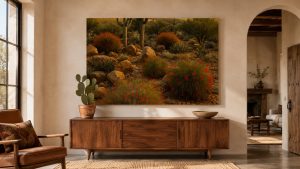
Best pieces for a single statement display are wide landscape compositions with strong color and enough visual weight to anchor a wall on their own.
Choose a piece with enough visual weight to hold the wall on its own. Wide landscape compositions with strong color and dramatic light work best here — you want something that commands the space from across the room, not just up close.
Best for: Living rooms, bedrooms, dining rooms, and offices. Any wall where the art is the focal point.
Sizing guide: For a wall above a sofa or headboard, the print should be roughly two-thirds the width of the furniture below it. A 30” × 40” or larger canvas makes the strongest impression.
Choose a piece with enough visual weight to hold the wall on its own. Wide landscape compositions with strong color and dramatic light work best here — you want something that commands the space from across the room, not just up close.
The Horizontal Pair
Two prints, side by side, reading like a single panoramic moment.
A horizontal pair creates a sense of continuity that a single piece can’t. Hung three to four inches apart, two landscape prints span a wide wall and draw the eye across the full composition. The gap between the frames becomes part of the arrangement — a visual breath that lets each piece speak while keeping them connected.
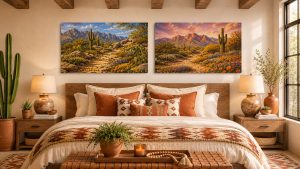
Two complementary prints span the wall, creating a panoramic effect — one landscape, two perspectives.
The strongest pairs share a color palette or subject but are not identical. Sunrise and sunset. Spring bloom and autumn warmth. Two views of the same ridge from different seasons. The viewer reads them together and fills in the story between them.
Best for: Above king-size beds, long sofas, dining benches, or any wide horizontal wall space that feels too broad for a single piece.
Sizing guide: Two prints of equal size, both in landscape orientation. 24” × 18” or 30” × 20” each, with 3–4” between frames. The combined width should be roughly two-thirds of the width of the furniture below.
The Vertical Pair
Portrait orientation. Tall, deliberate, and suited to spaces where width is limited but presence is not.
Not every wall calls for a wide arrangement. Entryways, hallways, the space between two windows, the wall flanking a fireplace — these are vertical spaces, and they deserve art scaled to fit them. Two portrait-oriented prints hung side by side bring height and intention to a narrow wall without overwhelming it.
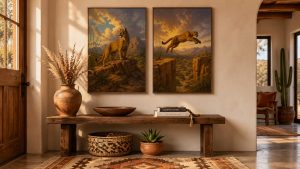
A vertical pair brings presence to narrow spaces — entryways, hallways, and the walls between windows.
Choose pieces with strong vertical compositions — tall saguaros, standing wildlife, desert doorways, upward perspectives on mountain ridgelines. The portrait orientation draws the eye upward, making even a modest wall feel more open.
Best for: Entryways, hallways, powder rooms, narrow wall segments between windows or beside doorways.
Sizing guide: Two equal-size prints in portrait orientation. 16” × 24” or 20” × 30” each, with 3” between frames.
The Triptych
Three pieces in a line. The gallery approach.
A triptych creates rhythm. Three equally sized prints in a horizontal row establish a visual beat that carries the eye from left to right, and the arrangement reads as a curated set rather than individual purchases. This is the layout you see in galleries and design magazines, and it works because the repetition of equal frames gives even diverse subjects a sense of unity.
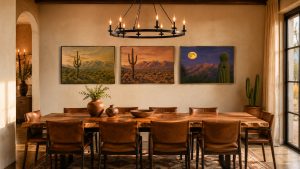
Three prints, one story. A triptych creates gallery-level rhythm on any long wall.
The most compelling triptychs tell a story across three frames. Dawn to dusk. Calm to storm. Trail to ridge to sky. Choose three pieces that share a thread — a color, a subject, a season — and hang them with equal spacing. The viewer will read the narrative you’ve built.
Best for: Above long sofas, dining tables, conference tables, or any extended horizontal wall. Particularly effective in open-plan living areas where the art needs to hold its own across a large space.
Sizing guide: Three prints of equal size in landscape orientation. 20” × 16” or 24” × 18” each, with 3–4” between frames. The total span should sit within the width of the furniture below.
The Centerpiece
A larger print in the center, flanked by two smaller pieces. Hierarchy, balance, and a clear focal point.
This arrangement gives you the best of both worlds: the commanding presence of a statement piece and the visual interest of a curated grouping. The center print — larger and typically in portrait orientation — draws the eye first. The two flanking pieces, smaller and in landscape orientation, sit at the vertical midpoint of the center, providing context and depth.
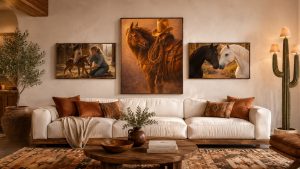
A larger center piece flanked by two smaller prints creates hierarchy and visual depth — the gallery-curated approach.
Think of the center as the lead voice and the flanking pieces as harmony. A bold wildlife portrait in the middle, bracketed by two quieter landscapes. A dramatic storm scene flanked by the calm before and after. The centerpiece earns the wall; the flanking pieces complete the composition.
Best for: Feature walls in living rooms, above sofas and sectionals, master bedrooms, or any space where you want a gallery-curated look with a clear focal point.
Sizing guide: Center piece: 24” × 36” or 30” × 40” in portrait orientation. Flanking pieces: 20” × 16” or 24” × 18” each in landscape orientation, centered vertically against the middle print. Leave 3–4” between each frame.
Two Over One
Two smaller prints above, one larger print below. A modern arrangement that breaks the single-row expectation.
Stacking prints vertically adds a dimension that horizontal arrangements can’t. Two intimate pieces on the upper row — close-up details, wildlife portraits, botanical studies — draw the viewer in. The larger landscape grounds the arrangement and provides the wide-angle context. The eye moves naturally: detail, detail, then the full scene.
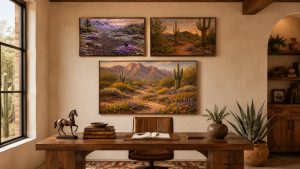
Intimate details on top, the full landscape below. A stacked arrangement that rewards a closer look.
This layout works especially well when the top pieces are subjects found within the bottom piece’s landscape. Wildflower close-ups above a sweeping desert trail. Owls perched above the canyon in which they hunt. The arrangement becomes a zoom — from the intimate to the expansive.
Best for: Home offices, studies, reading nooks, or any space where you want visual interest without the horizontal footprint of a three-in-a-row arrangement.
Sizing guide: Upper row: two prints at 16” × 12” or 20” × 14” each, side by side. Lower print: 30” × 20” or 36” × 24”, centered below. The combined width of the upper pair should roughly match the width of the lower print. Leave 3” between all frames.
The Stairway Collection
Three prints ascending a stairway wall, each one a step in a visual journey.
Stairway walls are some of the most underused spaces in a home. The ascending angle creates a natural diagonal that smaller prints can follow, turning a transition space into a gallery walk. Three pieces of matching size, staggered to follow the stairs’ slope, give the viewer something new to discover with each step.
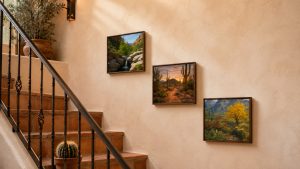
Three prints follow the stairway’s angle, turning a transition space into a gallery walk.
The key is sequence. Arrange the pieces so they tell a story as you climb — close to far, calm to dramatic, earth to sky. A desert doorway at the bottom, a ranch scene in the middle, a frontier landscape at the top. Or three wildlife pieces ascending in scale: songbird, coyote, mountain lion. The stairway does the pacing for you.
Best for: Stairway walls, tall, narrow walls, split-level transitions, or any space with a natural vertical flow.
Sizing guide: Three prints of equal size, 16” × 12” or 20” × 16” each. Stagger them diagonally, following the angle of the staircase, with the center of each print at roughly the same height above the nearest step. Leave 6–8” between frames to account for the diagonal spacing.
Need Help Choosing?
Every wall is different, and so is every collection. If you’re not sure which arrangement fits your space — or which pieces work best together — we’re here to help. Send us a photo of your wall, and we’ll recommend sizes, orientation, and pairings from the collection.
All Sonoran Art prints are produced on museum-quality materials and made to order in your choice of canvas, fine art paper, or metal mounting. Every piece is carefully packaged and shipped anywhere in the U.S.
Contact us to start planning your wall, or browse the full collection to find the pieces that belong in your home.
Answers the Most Common Questions. Clearly and Confidently.
Processing & Delivery
Each print is made to order. Please allow 10-14 business days for preparation and shipping.
Metal Mounting
Select prints can be mounted on metal panels in sizes up to 30" x 30", 40" x 40", and beyond. Metal mounting delivers a sleek, modern presentation with exceptional color vibrancy and durability. Contact us to determine if your selection is available for metal mounting.
About Giclée Prints
Giclée (pronounced "zhee-clay") is a museum-quality fine art printing process renowned for exceptional color accuracy and lasting detail. Every Sonoran Art print is produced using this process, ensuring your artwork maintains its richness and depth for decades.
Canvas Prints
All standard Sonoran Art prints are Giclées produced on premium canvas, available as stretched or rolled. Stretched canvas pieces are carefully hand-stretched on solid wooden frames, delivering vivid, lasting color in a gallery-ready presentation.
Fine Art Paper
Fine art paper prints offer a classic gallery aesthetic with exceptional depth and detail. Produced on thick, archival-grade, acid-free paper, these prints are built for longevity and available in sizes from 4x6" to 40x60". Contact us to order Fine Art Paper prints.
The Sonoran Art Promise.

Print Quality
Every Sonoran Art print is produced using museum-quality Giclée printing on archival-grade materials — canvas, fine art paper, or metal and acrylic mounting. Rich color depth, precise detail, and materials engineered for longevity ensure your print looks as powerful years from now as the day it arrives.
Made to Order
No mass production. Every print is made individually when you order, giving each piece the attention it deserves from production through packaging.
Rooted in Original Artwork
Each print begins with original human-created work — acrylic paintings, field photographs, and drawings developed through our Digital Composition process. You are not buying a generic image. You are buying a composed piece of art with a genuine creative foundation.
Shipped with Care
Every order is carefully packaged and shipped anywhere in the U.S. Your print arrives protected and ready to display.
Guarantee Statement
Your satisfaction is our commitment. If your print arrives damaged or does not meet the quality we promise, we will make it right — no questions asked.